White label lending platform: What B2B marketplaces need to know
Learn how a white-label lending platform works for B2B marketplaces and when embedded invoice financing may be a better fit.

If you run a B2B marketplace, you already know the story: suppliers want to get paid fast so they can keep operations running, while buyers tend to demand 30/60/90 payment terms.
Advancing cash to suppliers can help close that gap. Sellers could use the funds to cover expenses, stock up, and sell more while buyers still get to pay later down the line.
These extra funds could come in the form of a traditional loan: for example, a branded loan offered through a white-label lending platform, where a third-party provider handles the underwriting, capital, and compliance while the experience remains fully embedded in your marketplace.
But as we’ll explore in this article, embedded invoice financing is usually the easier and lower-risk approach. Rather than borrow an arbitrary amount to help with cash flow, sellers sell their unpaid invoices to a financing provider. Since no loan is being issued in this scenario, there’s no balance-sheet impact, no interest, and no repayment schedule.
The seller simply gets paid early, and the financing provider recoups the money directly from the buyer once they settle the invoice.
To maintain full control and keep the user experience under your own brand, you might have considered building an in-house solution. But this comes with lots of moving parts, including managing credit risk, compliance, and cash flow.
A white-label platform, on the other hand, lets you offer fast, branded payouts to sellers without taking on those headaches yourself.
In this guide, we’ll look at:
- Why using your own capital to lend to suppliers can be challenging
- Which issues a white-label lending platform can solve – and where embedded invoice financing may be a better fit
- What to consider when choosing the right solution for your business needs
- How Aria helps marketplaces offer branded and frictionless payments to suppliers
- Case study: How UrbanChain achieved 10x growth with Aria and sped up vendor payments
Aria is an embedded invoice financing solution that helps B2B marketplaces, SaaS vendors, and other businesses speed up supplier payments without tying up their own cash. Get a demo to see how we can help you.
Why using your own capital to advance cash to suppliers can be challenging
First off, lending and financing are two very different models, especially in the eyes of regulators.
In fact, most marketplaces can’t legally offer loans to their customers without proper authorisation. In the UK, for example, that means seeking approval from the FCA – a long and formal process that’s far outside the scope of most marketplaces’ business needs.
This makes building an in-house lending program almost impossible.
Financing is different. It involves purchasing invoices rather than issuing credit, which means you don’t need regulatory authorisation. That’s why some marketplaces use their own cash to finance their suppliers’ invoices.
However, this route isn’t without bumps, either:
- Your cash gets tied up and scaling becomes harder. Every amount you advance to sellers is money you can’t reinvest in your marketplace. As your user base expands, trying to fund everyone from limited reserves quickly becomes unsustainable. If you want to keep scaling without stretching yourself too thin, partnering with a third-party funder is eventually unavoidable.
- You take on credit risk and debt collection. There’s always a chance a buyer pays late, misses a payment, or doesn’t pay at all. When that happens, the responsibility falls on you. You now have to dedicate time and resources to chasing down payments and resolving disputes. And if the buyer can’t pay an invoice, you may have to absorb the loss.
- You have to fulfil complex compliance and fraud prevention requirements. Credit underwriting, identity verifications via robust KYC/KYB checks, setting up anti-money laundering and fraud protections, and more – when you finance sellers, none of these are optional. Even with third-party tools, juggling multiple partnerships and integrations adds friction, which can lead to slower growth.
Which issues a white-label lending platform can solve – and where embedded invoice financing may be a better fit
Partnering with a third-party platform can relieve the pressure of funding suppliers yourself. Both white-label lending platforms and embedded invoice financing platforms offer many of the same perks:
- No need to tie up your own cash. The platform provides the funds.
- Your brand stays front and centre. Everything happens within your marketplace, giving users a smooth and on-brand experience.
- Collections are handled for you. Lenders are responsible for collecting payments from suppliers, while invoice financing platforms collect from buyers.
- Built-in compliance and fraud management. Most lending and invoice financing platforms have built-in safeguards, though the robustness depends on the provider.
Despite these similarities, though, embedded invoice financing is usually the better choice for B2B marketplaces – not just because it fits naturally with how transactions already work, but also because this option is more comfortable and less risky for sellers.
With a lending platform, suppliers are taking on a loan. This means taking on debt, which then introduces several issues:
- Small businesses and sole traders are facing personal risk because they need to put their personal assets on the line as a guarantee of repayment.
- Interest can accumulate, repayment obligations build up, and loans can ultimately add to existing cash-flow stress instead of relieving it.
- Loans appear as liabilities in financial statements, which is especially painful for larger companies, as this can impact investor relationships, creditworthiness, and eligibility to alternative financing options later down the road.
Invoice financing is much simpler: here, suppliers sell a specific invoice to the financing provider through your platform and receive cash upfront. There’s no debt, no interest, and no repayment schedule.
And crucially, if the buyer doesn’t pay, it’s the financing provider – rather than the supplier or the marketplace – who takes the financial hit. This makes embedded invoice financing much more straightforward and easier to manage.
What to consider when choosing the right white-label solution for your B2B marketplace
Before choosing your ideal funding partner, you need to be clear on what matters most for your marketplace. Here are some questions to ask:
1. Who takes on the credit risk?
Understanding where credit risk sits is vital: it affects your operational burden, your relationships with suppliers, and how confidently you can offer early payouts.
White-label lending platforms extend a loan to your supplier. In this setup, the supplier becomes the borrower and is responsible for repaying the loan. Depending on the agreement, if the supplier can’t repay, the lender may turn to you for repayment, or you may have shared liability. It varies by contract.
Embedded invoice financing providers fund the supplier and collect repayments from the buyer. If the buyer doesn’t pay, the financing provider often absorbs the loss, which shifts risk away from both you and your suppliers.
But not all financing partners work this way. Some pass the risk back to the marketplace or supplier: if a buyer defaults, you or the seller must chase the funds. This ends up complicating your operations.
For marketplaces, the ideal partner will absorb the risk so neither your cash flow nor supplier relationships are impacted by non-payment.
2. Is the application process simple for your users?
The best funding platforms keep the application experience smooth and on-brand: users can apply, upload documents, and get verified directly within your interface. Bonus points if the platform can pull relevant information from your existing records so that customers don’t have to type everything in again.
It’s also worth noting that lending platforms typically require far more documents in order to make their underwriting decisions, which means access to financial statements, future revenue projections, banking data, and more. This can make the application process much more complex.
Invoice financing decisions are simpler and faster because they’re tied to a specific asset: the invoice itself. Once KYB is complete, the financing provider can either approve or reject the request.
Automation is something to take into account, too. Does the platform offer automated underwriting and instant decisioning, or does every application sit in a manual review queue? Instant decisions make a big difference for users who want to know quickly if they’re approved for financing or lending.
3. Who manages the payment flow, and how flexible is it?
While standard loans through digital lending platforms come with no complex payment flows (the supplier simply receives and repays the loan), invoice financing is more nuanced.
This is because invoice-based payouts demand more complex flows, especially where marketplaces with complicated buyer–supplier relationships are concerned: there are often different fees, commissions, splits, and recipients involved.
When evaluating embedded invoice financing platforms, ask:
- Does the platform handle the payout flow end-to-end?
- Can it adapt its functionalities to your specific needs?
- Will funds be distributed automatically to the right parties?
The best platforms slot neatly into your existing payment flow instead of forcing you to rebuild it around them.
4. How does the platform handle collections?
Collections work differently depending on the business model: lenders expect suppliers to repay the loan, while invoice financing providers collect invoice-based repayments directly from buyers.
But regardless of who is responsible for repayment, you want the platform to handle collections carefully and thoughtfully. Here are some questions to keep in mind:
- What is their communication style with users?
- Which channels do they use, and how frequently?
- Do you have visibility or input into the process?
The way collections are handled affects your relationship with your users and their overall experience, so make sure to choose a platform that protects your marketplace’s reputation and aligns with the tone and values of your brand.
5. Do they support both suppliers and buyers?
If suppliers get issued a loan, the buyer side of the transaction is still left out. Embedded invoice financing, on the other hand, can often support both: suppliers get early payouts, and buyers can get 30/60/90 day payment terms.
This matters because serving both sides of the marketplace can make your offering much more attractive: suppliers get consistent cash flow, buyers stick to their regular payment terms, and your marketplace becomes the place where everyone can manage payments in a way that works best for them.
This gives you a competitive advantage and reduces the risk of disintermediation (buyers and suppliers completing transactions outside your marketplace).
How Aria helps marketplaces offer branded and frictionless financing to suppliers
We initially built Aria for B2B marketplaces. Embedded right into your platform, we’re an invoice financing solution that enables suppliers to get paid within 24 hours securely and under your own brand. With 65+ live clients, we’ve already funded over £1 billion to more than 100k beneficiaries.
Here’s what you can expect from partnering with Aria:
Offer instant payments to suppliers and regular payment terms to buyers while keeping your brand front and centre
Financing suppliers yourself is risky and expensive. Cash flow gets tied up, credit risk falls on you, and building an in-house solution that’s compliant is a huge investment. Third-party solutions can help, but you risk inconveniencing users and losing control over their experience.
With Aria, you can quickly advance funds to suppliers and offer regular payment terms to buyers without dipping into your cash reserves.
Better yet, users can access these services without ever leaving your platform. Buyers and suppliers onboard themselves, data flows automatically from your systems to ours, and invoices are pulled in as they’re generated. Aria runs quietly behind the scenes, so users stay engaged and loyal to your brand.

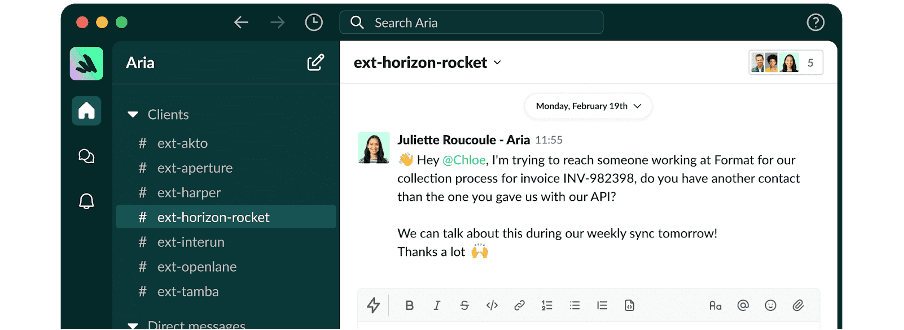
Plus, Aria typically takes on the credit risk and debt collection. If a buyer defaults, we absorb the loss. When payments are late, we approach recovery with dialogue and tact. You can even work with us to design a custom debt collection workflow that’ll protect your relationship with your customers.
Let Aria handle the compliance side
For financing to be safe and secure, you need solutions and processes that can manage compliance, fraud prevention, and credit risk. But building and maintaining these systems yourself – or even juggling multiple providers – is costly and complex.
At Aria, compliance is built in. We always follow the most up-to-date regulatory processes, with a robust system that:
- Handles KYC/KYB identity checks for users in over 100 countries and uses a fraud detection engine that analyses external data to flag suspicious activity.
- Assesses debt solvency and recommends appropriate credit limits for each counterparty – our current default rate is below 0.1%.
Tracks buyer-validated invoices using clickwrap, email confirmations, and other methods to anticipate and prevent disputes before they happen.
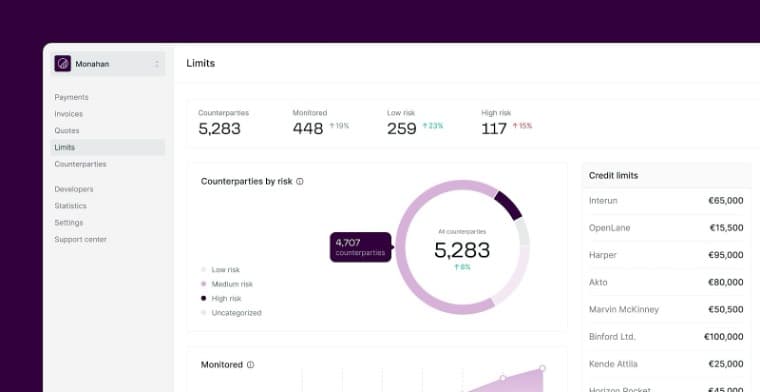
Automation makes all of this fast and frictionless. In most cases, we only need a company registration ID to determine financing limits and advance funds, and 92% of decisions are instant. That means your users can quickly start reaping the benefits of instant payments.
Attract and serve more suppliers with a solution built for scale
As a marketplace, you serve suppliers of all sizes, from large enterprises to small businesses. If your financing solution only works for larger players, you risk excluding a big portion of your user base – and losing them to competitors who can offer faster payments.
Aria is designed to include long-tail SMBs that traditional financing and lending solutions often overlook. We do this by underwriting the buyer rather than the supplier. That means you can offer instant payments to more suppliers, no matter how small they are, improve retention among existing users, and expand your customer base.
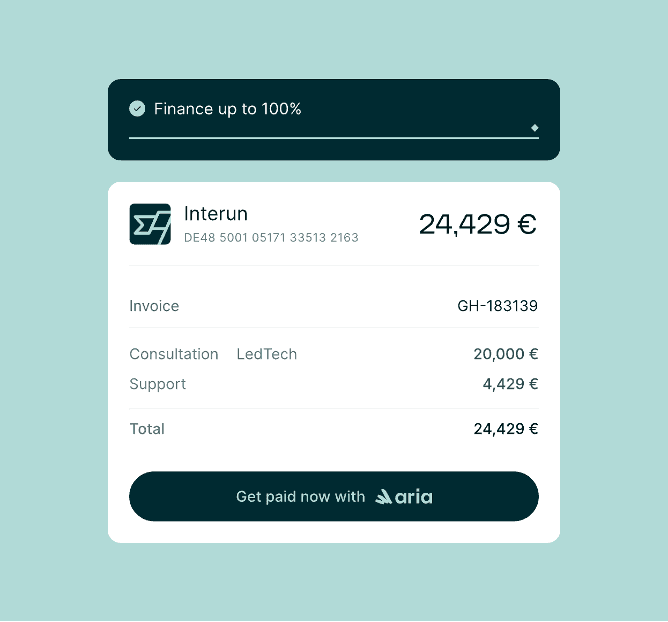
In fact, Aria is built to scale with you. We can handle high volumes effortlessly thanks to our self-service onboarding and automated processes. Even if your user base doubles overnight, our solution – with €2 billion in financing capacity – can keep up.
Plus, monetising invoice financing is flexible. You can:
- Absorb the fee and integrate it into general pricing
- Pass the fee on to your suppliers, for example via a small supplement
Either way, the customer experience is always smooth and frictionless.
How UrbanChain achieved 10x growth with Aria and sped up vendor payments
UrbanChain is a Manchester-based renewable energy platform that connects generators directly with consumers. The platform was scaling rapidly, but growth brought challenges. Bigger customers were demanding longer payment terms, while vendors needed quick payouts to keep operations running.
Financing hundreds of invoices manually was becoming unsustainable, so UrbanChain needed a scalable solution that could handle:
- Line-by-line financing for vendors with different credit profiles
- Complex underwriting for big buyers with longer payment terms
- Automation for high-volume invoice processing
UrbanChain chose Aria for its flexibility and tech-driven capabilities. Through Aria’s API integration, the energy platform implemented automated financing that fit their workflow.
Vendors received line-by-line financing, invoice processing became faster and smoother, and UrbanChain’s team benefited from dedicated support and proactive check-ins.
Results include:
- £11M financed through Aria
- Vendor payments reduced to 15 hours
- Revenue skyrocketed 10x in just one year, from £2.4M to £25M
By embedding Aria into their platform, UrbanChain kept the UX familiar and the financing invisible while scaling confidently.
Embedded invoice financing is the smarter way to fund marketplace suppliers
A white-label financing platform like Aria enables you to offer faster payments to suppliers while keeping your brand front and centre. The result is a consistent and integrated experience for your users – no extra accounts, redirects, or interruptions.
Plus, you don’t need to dip into your own funds, take on credit risk, or manage collections. This lets you focus on what matters most: growing your marketplace, all with a financing solution that scales with you.
Want to see how it works? Explore Aria’s white-label solution today.
FAQs: White-label lending platform
What is a white-label lending platform?
A white-label lending platform enables businesses – including marketplaces – to offer financing under their own brand without becoming a lender themselves. The platform provides the financial services and technology, while the business retains control over the user experience, branding, and customer relationships.
How does a white-label lending platform work for B2B marketplaces?
A white-label lending platform lets B2B marketplaces offer lending directly within their own product and under their own brand. Suppliers and buyers can access funding options through the marketplace, the lending partner provides the working capital in the background, and repayment happens based on agreed terms. All of this happens on your platform under your branding, keeping the experience smooth for your users.
Does a white-label financing platform like Aria also handle fraud detection?
Yes, platforms like Aria include built-in compliance and fraud protection. They perform identity checks (KYC/KYB), monitor for suspicious activity, and more to ensure that financing decisions and payments are safe and secure.
Should we build our own financing or lending solution instead of using a white-label platform?
Building your own solution gives you full control, but it also means taking on everything yourself: capital provisioning, underwriting, compliance, collections, fraud prevention, and ongoing maintenance. For lending, you would also need regulatory authorisation, which comes with a lengthy and stringent approval process.
Using a white-label platform, on the other hand, lets you offer the same seamless, branded experience without becoming a lender or maintaining your own financing infrastructure. You keep the UX, but the provider handles the risk and regulatory burden. This means that, for most marketplaces, using a white-label platform for financing or lending is faster, less complicated, and more scalable than building one yourself.