How to secure payments on marketplaces: 7 strategies to know
How can marketplaces secure payments and reduce fraud? Discover 7 strategies to protect transactions, manage risk, and improve cash flow for buyers and sellers.

Unlike traditional e-commerce, marketplace payments aren’t straightforward buyer-to-merchant flows. With at least three parties involved – the buyer, seller, and marketplace – every transaction depends on money moving between the right people, for the right amount, and at the right time after conditions are met.
Without strong payment security, your marketplace opens the door to:
- Buyers paying and not receiving goods or services
- Sellers delivering and not getting paid
- Payments being misdirected, duplicated, or released too early
- Chargebacks and refund abuse
- Scams, fraud, and stolen data
And when things go wrong, it’s usually the marketplace pulled into the middle. Even if you’re not legally liable, payment issues can still increase churn and damage your reputation: when users distrust your payment flow, they may hesitate to transact or end up leaving your platform altogether.
That’s why marketplaces need more than basic payment processing.
Securing marketplace payments means putting safeguards in place so funds only move to the right parties when agreed conditions are met, while sensitive financial data stays protected. At the same time, those safeguards shouldn’t add friction or delay payouts for users who’ve already earned trust.
In this guide, we break down seven ways marketplaces can make payments more secure – and how embedded invoice financing solutions like Aria can add an extra layer of protection between buyers and sellers without slowing your platform down.
Here’s what we’ll cover:
- 7 strategies to secure payments on marketplaces
- How embedded invoice financing helps protect cash flow with Aria
- How Aria powered secure payments for Hiway freelancers and helped them fund €1.5M
Aria is an embedded invoice financing solution built for B2B marketplaces. Find out how we can help you protect and improve your users’ payment experience with a free demo.
7 strategies to secure payments on marketplaces
Fraud and payment failures rarely come from just one weak point. They happen when several vulnerabilities are exploited across onboarding, checkout, payouts, and everything in between.
That’s why payment security on marketplaces needs a layered approach: one that combines identity checks, transaction controls, real-time monitoring, and smart rules around when and how money moves. At the same time, the experience must stay frictionless so buyers and sellers don’t abandon the flow.
Here are seven ways you can make your marketplace payments more secure:
1. Protect sellers’ cash flow and speed up growth with invoice financing
Suppliers often want to get paid early, but buyers typically pay on net 30, 60, or 90 terms. That gap can squeeze sellers’ cash flow, making it harder for them to fund operations or invest in growth. Invoice financing solves this by helping sellers get paid early, before the buyer settles the invoice.
Here’s how it works: a third-party financing provider advances a portion of the invoice amount to the seller, while the buyer keeps their regular 30-90-day payment terms. Once the buyer pays, the financing provider is reimbursed.
For marketplaces, working with an invoice financing provider means:
- Your sellers get paid faster without you having to advance funds
- Buyers keep standard terms and protections
- In the case of non-recourse financing, neither you nor the seller bears the credit risk if the buyer can’t pay
Invoice financing also adds a trusted middle layer between buyer and seller, with a third party managing funds and helping prevent disputes by controlling when and how payments are released. At the same time, it keeps cash flowing for reliable sellers, so security doesn’t come at the expense of growth.
2. Apply adaptive Strong Customer Authentication to prevent reduced conversions
Strong Customer Authentication (SCA) is a European regulatory requirement under the Payment Services Directive (PSD2). In short, it requires extra checks to confirm a payer’s identity before a payment goes through.
SCA usually means verifying at least two of the following:
- Something the user knows (like a password or PIN)
- Something they have (like a phone or security token)
- Something they are (like a fingerprint or face scan)
Done well, SCA significantly reduces unauthorised online payments and account takeovers. Done poorly, it slows down checkout and hurts your conversion rates.
Adaptive, or risk-based, SCA is a smarter approach that puts extra checks where they matter most. Instead of forcing every user through the same steps, you apply stronger authentication only when a transaction looks risky, such as when a new user makes a high-value purchase, the account is logging in from an unusual location, or when changes have been made to payout details.
While higher-risk payments get an extra layer of verification, low-risk or repeat transactions get to move through with minimal friction. This ensures security without slowing down the users you trust.
3. Automate KYC/KYB checks to speed up customer onboarding
Marketplace security starts with knowing who’s on your platform. Bad actors, like fake sellers or shell companies, can compromise your marketplace before a single transaction happens by using stolen identities or disappearing after payout.
That’s why marketplaces are required to conduct KYC (Know Your Customer), KYB (Know Your Business), and AML (anti-money laundering) checks. These are identity verification processes that help prevent fraud:
- KYC confirms a person is who they say they are. This usually involves verifying ID documents, checking addresses, and screening against sanctions or watchlists.
- KYB confirms a business is legitimate. It verifies business registration details, ownership structures, and checks against corporate watchlists or politically exposed persons (PEPs).
The challenge is that manually conducting these checks can be slow and inconvenient, requiring users to email documents or upload them to third-party portals and wait days for review and approval.
By opting for an automated KYC/KYB solution embedded directly into your platform, you can verify identities and businesses quickly and do so without forcing users off your platform or making them deal with manual bottlenecks.
4. Detect fraud with AI-driven behavioural risk scoring
Fraud detection tools traditionally rely on fixed rules – like flagging large transactions or odd IP addresses – but these rules struggle to keep up with modern fraud tactics and may even block legitimate users.
Behavioural risk scoring, on the other hand, uses AI to analyse how users interact on your platform over time. In doing so, it’s able to quickly spot anomalies like unusual login patterns or sudden changes in transaction activity.
By focusing on behaviour rather than isolated data points, marketplaces can catch fraud earlier and reduce false positives. It also works to keep the user experience smoother. While suspicious transactions are flagged before money moves, your trusted buyers and sellers can continue their normal activities uninterrupted.
See how Aria’s AI-powered risk analysis system can help you securely process payments.
5. Use real-time monitoring to stay on top of unusual payment activity
If you wait until the end of the day, week, or month to catch payment issues, losses like failed payouts or fraudulent transactions may already have stacked up. Real-time monitoring tracks activity as it happens, giving you immediate visibility into risk.
This helps you:
- Spot spikes in chargebacks, refunds, or failed payments
- Detect unusual buyer or seller behaviour
- Pause transactions or payouts before losses get out of hand
Continuous monitoring also helps create detailed logs that can be pulled for audits, regulatory compliance checks, and dispute resolution.
6. Employ escrow-style holding with risk-based payouts to protect funds without delaying trusted sellers
One of the trickiest parts of marketplace payments is making sure funds are released only when everyone’s obligations are met. Buyers don’t want to pay and get nothing in return. Sellers don’t want to deliver a product or service without knowing they’ll get paid.
Escrow helps solve this trust problem by acting as a neutral middleman that holds the funds until agreed-upon conditions are met. This way, buyers get peace of mind that their money is protected, and sellers know they’ll get paid once they’ve done their part.
That said, putting everything into escrow can frustrate trusted sellers because it delays access to funds they need to run their business.
Risk-based payouts offer a smarter solution: reliable sellers can access their money quickly, while new or higher-risk transactions stay in escrow a bit longer. This approach protects buyers while keeping top-performing sellers’ cash flow smooth and predictable.
7. Use split payments to control where money goes and limit fraud exposure
Split payments can also give you more control over how funds move. For instance, you can hold a total payment in escrow, then automatically divide it into separate portions, such as seller payouts, marketplace fees, or partner commissions.
Funds are then released to the right parties only when conditions for those specific portions are met.
This helps you:
- Limit unnecessary access to funds by ensuring sellers, service providers, and partners only ever receive the portion they’re entitled to
- Isolate marketplace fees from seller payouts, so your revenue is better protected or easier to recover if disputes, refunds, or chargebacks occur
- Automate fees and compliance by automatically routing commissions, taxes, or reserves, which cuts down on manual errors and disputes
How embedded invoice financing helps protect cash flow with Aria
As a marketplace, you have to balance conflicting demands: buyers expect long payment terms, while sellers need cash fast. Aria, an embedded invoice financing solution built for B2B marketplaces, can help you manage both sides.
With €2 billion in financing capacity and 65+ live clients, Aria enables you to offer instant or accelerated payouts to sellers without changing buyer terms.
Here’s how we fit into your payment flow:
- Buyer onboarding happens directly on your platform. Business buyers register with Aria without ever leaving your marketplace.
- Buyers are assessed, and credit limits are issued securely. Aria’s APIs assess buyer solvency, verify identities (KYC/KYB), and screen for suspicious and fraudulent activity before approving buyers. Most decisions (92%) are made instantly, so you get security without the wait.
- Buyers check out as usual. Approved buyers complete their purchase on your platform, keeping the payment terms they prefer.
- Sellers request secure instant payment for eligible invoices based on the buyer’s credit limit. Our simple invoice validation process helps reduce overpayment and disputes by ensuring sellers only get paid for invoices approved by buyers.
- Funds are released securely, often within 24 hours. Aria advances up to 100% of the invoice to the seller – or to you, if your marketplace acts as an intermediary.
- Buyers pay Aria on the original invoice terms. Our APIs automatically manage all payment flows, ensuring money lands in the right hands. Marketplace teams can also monitor the full lifecycle of each transaction and invoice through our easy-to-use dashboard.
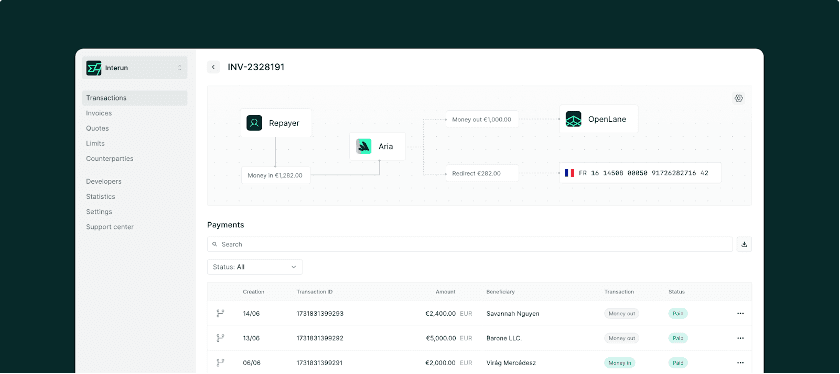
Here are other benefits to implementing Aria:
Protect buyers and sellers while reducing disputes and encouraging more transactions
By sitting in the middle, Aria adds an extra layer of protection that helps keep payments secure for everyone.
A key part of this is invoice validation: funds are only released once an invoice is approved. That one step reduces the risk of disputes and makes the whole payment flow clearer for both sides:
- Buyers confirm invoices before Aria advances payment, so they can verify goods or services were delivered while keeping their regular payment terms.
- Sellers no longer have to wait 30-90 days to get paid. Aria can advance up to 100% of the invoice as soon as an invoice is approved. We then collect payment from the buyer and can even absorb the loss if the buyer defaults.
This works especially well for service marketplaces, where validation can be as simple as a buyer clicking to confirm the work is done.
As for how invoices are validated, that will be discussed with your dedicated implementation manager. There are several ways to set this up:
- You can validate invoices in your own system and notify us via the create invoice validation endpoint in the API.
- If you don’t have a buyer-facing flow, we can contact the buyer directly.
- If you have a debtor interface but no validation step, you can embed our invoice-validation widget so buyers can confirm with one click.

Ultimately, invoice financing helps you pay your sellers faster, while offering flexible payment terms for buyers. This model makes it easier for buyers to spend more and for sellers to take on more work, driving higher transaction volumes across your marketplace.
Verify identities and reduce risk with KYC/KYB and fraud detection
Even with a neutral intermediary in place, you still need to know who’s transacting on your marketplace. That’s why Aria layers identity checks and fraud monitoring directly into the invoice financing flow.
First, buyers and sellers are verified with our embedded KYC and KYB checks across 100+ countries. This confirms real identities and legitimate businesses before invoices are financed.
From there, Aria monitors behaviour across the marketplace. We look at factors like how invoices are validated, unusual transaction timing, and repeat patterns that signal disputes or fraud. Our fraud detection engine combines AI-driven analysis with rule-based controls to help spot risk early without disrupting normal activity.

On top of that, your buyers are thoroughly assessed for creditworthiness before they can join the invoice financing program. Credit limits reflect what a buyer can realistically afford, which means only invoices from eligible buyers can be financed in the first place.
And if a buyer does default on a financed invoice, you’re protected. Aria offers non-recourse invoice financing, which shields you and your sellers from payment defaults on most financed invoices. We handle collections in-house and absorb losses caused by buyer insolvency or late payments.
Once you’re able to handle more risk, you can choose how much protection you want: go fully non-recourse for maximum coverage, or mix recourse and non-recourse on a per-invoice basis in exchange for higher credit limits.
Easily embed invoice financing into your system
Securing marketplace payments shouldn’t have to mean juggling multiple providers or overhauling your existing setup.
Aria is built to fit into your marketplace: think of the solution as a B2B toolkit that adapts to your product and workflows. You can plug our flexible REST APIs into any part of your existing setup that generates invoice data, whether that’s your marketplace backend, POS, ERP, or CRM. As long as we receive invoice information, we can work with it.
If you have an existing PSP, Aria can work alongside it. You keep the security features your PSP already provides, while we add invoice financing and risk protection on top.
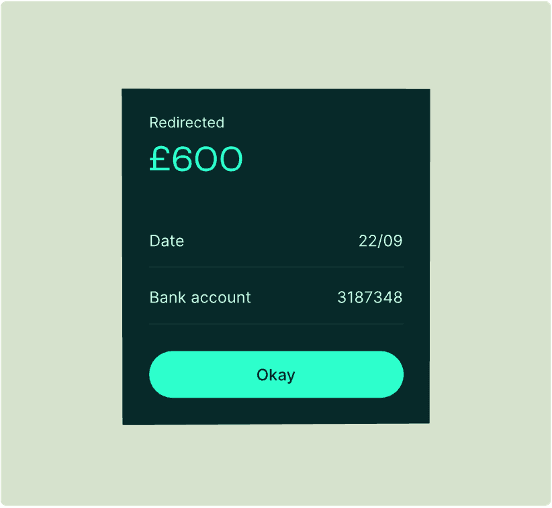
For your users, everything is fully white-labelled. Buyers and sellers stay on your platform from onboarding to payout, with no redirects or broken journeys. Your marketplace remains front and centre for users during every step of the payment experience.
Behind the scenes, integrating Aria is easy. You can start small with our manual dashboard, then move to a full API integration when your team is ready.
Along the way, we work closely with you, running workshops to understand your needs and align on messaging, user flows, and when collections should happen. The goal is to make the whole experience feel native to your product.
How Aria supported Malt’s expansion to 40+ countries
Malt is a leading European freelancing platform, helping more than 70,000 companies collaborate with 700,000 independent experts across a wide range of fields. As the business grew, Malt faced two key challenges.
First, it needed to bridge the gap between freelancer payments and client repayments. Freelancers expected quick access to their earnings, while clients continued to pay on standard terms.
Second, as Malt expanded internationally, it had to manage payments across multiple currencies and new markets, all while keeping operational overhead low and minimising manual data entry errors.
Through a seamless API integration with Aria, Malt freelancers can now access fast payments for their assignments in just a few clicks. In particular, Aria enabled:
- Fully embedded advance payments within Malt’s existing workflows
- Automated credit assessment, invoice validation, and advance payment processing
- Multi-currency support for €, £, and $
- Tracking of reimbursements and collections
This automation reduced the workload for Malt’s operational teams, minimised errors, and enabled the platform to manage high volumes of transactions more efficiently.
Today, Aria supports Malt across 45 countries and has financed more than 50,000 invoices. On average, invoices are financed in under nine hours, giving freelancers faster access to their earnings.
Read the full case study: Aria empowers Malt’s global expansion journey
Keep marketplace payments secure while paying sellers faster
Securing payments on a marketplace involves more than just preventing fraud or disputes – it’s also about giving buyers and sellers the confidence that every transaction will go as expected.
And when users trust the payment flow, they transact more, take on bigger orders, and stay loyal over time.
Aria adds an extra layer of security by acting as a neutral intermediary, advancing payments to sellers while collecting from buyers under agreed terms. This helps keep cash flowing for your trusted sellers – without slowing down your platform or changing how buyers pay.
Ready to secure your marketplace payments and ensure sellers get paid on time? Reach out for a free demo today.
FAQs: How to secure payments on marketplaces
1. How can I secure payments on my marketplace?
Securing payments means taking a layered approach. Start by verifying buyers and sellers with automated KYC/KYB checks, add risk-based authentication like 3D Secure and biometric verification, and monitor transactions in real time for stronger fraud prevention. Control how money moves with tools like escrow, split payments, or embedded invoice financing solutions like Aria to make sure funds go to the right parties at the right time.
2. What are the main risks marketplaces face if payments aren’t secure?
Without strong safeguards, online marketplaces can face fraud, scams, misdirected or duplicate payments, chargebacks, and disputes. These issues damage user trust and customer experience, leading to churn. Once users distrust your payment flow, they may hesitate to transact or leave the platform altogether.
3. How does invoice financing improve payment security?
Invoice financing adds a trusted middle layer between buyer and seller within modern payment systems. Sellers get paid faster while buyers get to stick to their regular payment terms and payment methods. This ensures funds move correctly, reduces the risk of disputes, and keeps cash flowing for trusted users.
4. Do marketplaces need a payment processor or payment gateway?
Yes, most secure marketplaces rely on a combination of payment gateways and a regulated payment processor to handle transactions safely. Providers like Stripe, Adyen, and other payment service providers help marketplaces streamline compliance and reduce fraud risk.
5. What payment options should marketplaces support to stay secure and competitive?
Marketplaces should include flexible but secure payment options in their checkout experience, including bank transfers, debit cards, credit cards, and digital wallets. Supporting local payment methods also helps improve conversion if you maintain secure and compliant payment processing through a trusted payment platform.