Marketplace payouts for scaling B2B platforms explained
Learn how marketplace payouts work and how to scale them with automated payout calculations, seller visibility into payout status, and embedded invoice financing.

Getting marketplace payouts right is about more than just paying your sellers. You also have to instill trust between parties that don’t know each other and balance extended buyer payment terms with seller expectations – all while trying to keep operational headaches to a minimum.
As an early-stage marketplace, you might have managed payouts yourself: collecting from buyers, paying sellers, and covering any gaps with your own cash when payments ran late. As your marketplace grows, though, manually juggling money, commissions, and payment terms quickly becomes unsustainable.
The good news is that growing marketplaces can adopt processes and tools that make payouts smoother, faster, and more predictable.
In this article, we’re covering:
- How marketplace payouts work
- How to optimise the marketplace payout experience as you scale
- How Aria improves B2B marketplace payouts with embedded invoice financing
- How Ubooker achieved 25% growth in booking volume by paying 3,000+ models faster with Aria
Aria is an embedded invoice financing solution that enables B2B marketplaces to pay users faster and securely. Find out how by booking a free demo.
How marketplace payouts work
Marketplace payouts are simple in theory: you move money from the buyer to the seller, minus your fees. In practice, payouts work differently depending on how your marketplace is structured.
In what we call the merchant of record model, the B2B marketplace sits between the buyer and the seller as the merchant of record. Here’s the typical flow:
- The buyer places an order. Checkout occurs on the marketplace, often with net payment terms like 30, 60, or 90 days.
- The seller invoices the marketplace for the agreed amount.
- The marketplace invoices the buyer. This invoice typically adds a markup that includes the marketplace’s commission, platform fees, or financing costs.
- The buyer pays the marketplace, whether by bank transfer, card, or direct debit. Funds may be held in a safeguarded or escrow account until settlement conditions are met.
- The marketplace pays the seller by the due date, typically via bank transfer. To avoid delays, marketplaces may pay sellers before collecting from buyers, using either their own cash or external financing. This is because there’s often a timing gap between when buyers pay and when sellers need payment.
In what we refer to as the platform/ facilitator model, the marketplace facilitates the transaction and invoices customers on behalf of sellers. The key difference here is that the contractual relationship is directly between buyer and seller. The marketplace uses a ledger or virtual account system (such as Stripe Connect or Lemonway) to split funds.
The process usually looks like this:
- The buyer checks out on the platform. Payment terms are agreed at checkout, potentially extending up to 90 days.
- The marketplace issues the invoice. The marketplace generates and sends the invoice in the seller’s name while also managing the payment flow.
- Funds are collected. Payment is received upfront or after the net term, typically through a PSP or escrow setup.
- Fees and commissions are deducted. Platform fees, taxes, and other charges are calculated before payout, sometimes in the form of a separate invoice, either to the buyer or the seller.
- Payouts are released to sellers. If the buyer pays late – or if sellers want faster payments – the marketplace may decide to finance supplier invoices to bridge the gap.
How to optimise the marketplace payout experience as you scale
Marketplace payouts can quickly become a bottleneck as your business grows. Manual processes, delayed payments, and unclear flows frustrate both your users and your team.
Here are five ways to improve the payout experience for all involved:
1. Automate payout calculations and flows
Split payments – where a single buyer payment is divided between multiple recipients – should happen automatically in the background. This includes allocations for multiple sellers, marketplace commissions, taxes, and platform fees.
For example, if a buyer pays a €10,000 invoice, you can set up automated flows that allocate €8,500 to the seller, €1,000 for your commission, and €500 for taxes or fees – without human intervention. Typically, this is done through a PSP (Payment Services Provider) like Stripe or Lemonway.
You can also automate reconciliation, including verifying that incoming funds match invoices, fees are correctly applied, and payouts align with actual settlements.
Automating these processes reduces manual error, ensuring sellers are paid accurately every time.
2. Speed up seller onboarding with automated KYC/KYB checks
Optimising payouts starts long before money is sent. If a seller isn’t verified, after all, they can’t get paid.
That’s why automating KYC/KYB and AML checks is one of the most impactful ways you can improve the payout experience: by removing manual verification delays, automated onboarding checks allow merchants to go live faster and accelerate the total transaction volume on your marketplace.
At the same time, automated compliance processes reduce the risk of human error, ensuring your platform meets regulatory requirements from day one.
3. Give sellers real-time visibility into payout status
One of the biggest frustrations for sellers is not knowing when they’ll get paid. A real-time, self-serve dashboard solves this by showing invoice status, pending payouts, deductions, and expected payment dates all in one place.
When sellers understand what’s happening and when they’ll get paid, trust increases between all parties, and your support team no longer has to spend too much time answering questions about where payments are.
Real-time visibility also makes cash flow planning easier for sellers. And when they can manage operational costs with confidence, they’re also more likely to stay active on your marketplace.
4. Let sellers choose when they get paid
Sellers don’t want to be forced into a payout schedule that doesn’t align with how their business actually operates. For many, expenses don’t line up with a fixed weekly or monthly cycle: payroll, supplier invoices, advertising costs, and inventory purchases can all fall on different timelines, and rigid payout rules make it difficult to plan around them.
Instead, empower your sellers to choose their own payout schedule, be it daily to maintain cash flow or monthly to simplify bookkeeping. This allows them to plan around a rhythm that actually works for their business.
You can also offer the option to accelerate payments on specific invoices via financing when sellers need faster access to cash.
5. Partner with an invoice financing provider to protect marketplace liquidity
When buyers pay late or operate on long net terms, marketplaces often take it upon themselves to advance cash to suppliers – and end up straining their own capital.
By partnering with an invoice financing provider, you can enable sellers to get paid early, without having to front the cash by yourself. This frees up funds that can be reinvested into your own growth.
How Aria improves marketplace payouts with embedded invoice financing
Aria is an embedded invoice financing partner with €2.5 billion in funding capacity and over €1 billion in transactions processed to date. We help B2B marketplaces pay suppliers faster by financing invoices and managing payouts, all without disrupting your user experience.
Our flexible APIs integrate directly into your existing workflows, keeping the experience white-labeled while automating financing and payment processes behind the scenes.
Here’s how Aria fits into your marketplace:
- Business buyers register for financing within your platform. No redirects, no friction.
- Aria handles KYC/KYB, solvency checks, and credit limit recommendations automatically. 92% of decisions are made instantly, speeding up user onboarding by reducing manual review.
- Buyers check out as usual. Orders and invoices are created using your standard marketplace flow and payment terms.
- Instant payments are requested when needed. You or your suppliers can request early payment for eligible invoices based on the buyer’s available credit. Dashboards provide visibility into invoice and payout status.
- Funds are released. Once the invoice is validated by the buyer – often with a single click – Aria pays you or your supplier, typically within 24 hours. 99% of payments are fully automated via our APIs.
- The buyer settles the invoice with Aria according to their agreed payment terms.
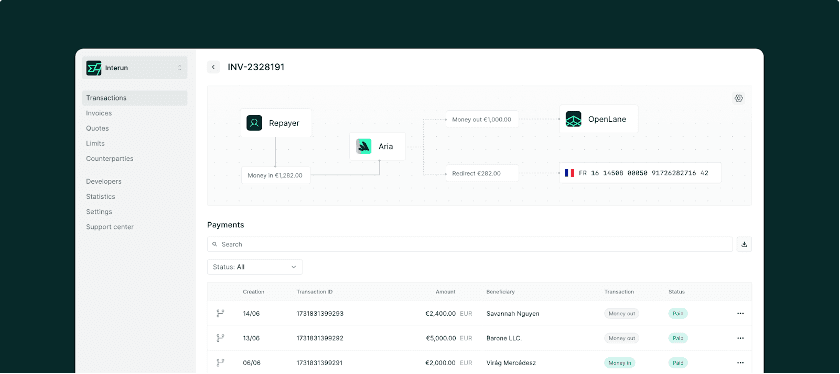
With Aria embedded directly into your marketplace, financing becomes a natural part of the flow – just like payouts. Here’s what you can expect with Aria:
Pay suppliers on time without dipping into cash reserves
30-90 payment terms are standard in B2B, but they create cash flow pressures for suppliers.
Whether you operate via the intermediary or platform model, the challenge is the same: someone needs to bridge the gap between invoice and settlement.
With Aria, you can ensure suppliers are paid on time without tying up your own capital. We can advance up to 100% of eligible invoices, often within 24 hours. Your suppliers get predictable, reliable payments, even while buyers keep their regular terms.
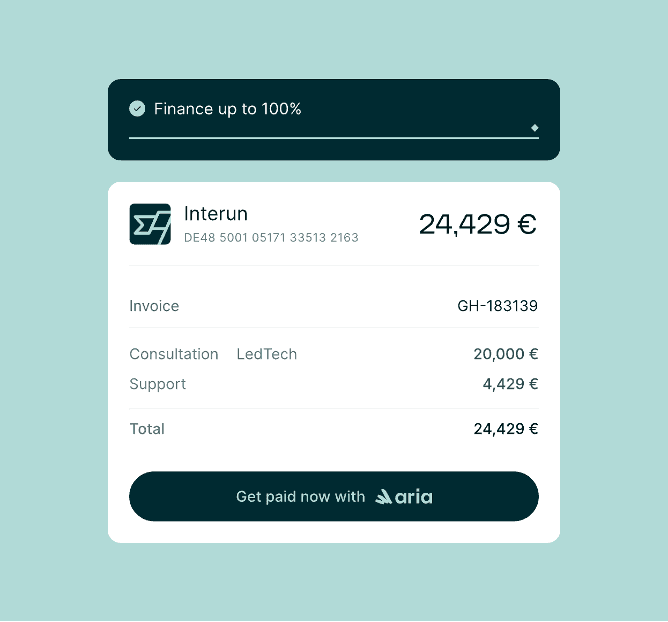
You also get to reduce your team’s operational load. Aria manages collections directly, so you don’t have to dedicate resources to chasing payments. Our recovery process is always human-centred, built on dialogue and tact, and we organise workshops to align on messaging.
We offer 100% protection against defaults under non-recourse financing. If a buyer fails to pay, we absorb the loss. Established marketplaces with strong financial footing also have the flexibility to mix non-recourse and recourse financing on a per-invoice basis, selectively taking on more risk in exchange for higher credit limits.
Offer instant payments to more users, including long-tail suppliers
Most B2B marketplaces work with a mix of suppliers, from large, established vendors to small, long-tail sellers. But traditional financing solutions struggle to serve this diversity.
Banks and factoring partners often require high annual volumes, expect you to finance every invoice, and underwrite the supplier (favouring only financially strong vendors). To finance their diverse users, marketplaces end up juggling multiple factors or even manually financing some invoices.
With Aria, you can offer instant payments to all types of suppliers. This is because we underwrite the buyer, not the seller, so even long-tail suppliers can access funding. In fact, Aria has one of the highest acceptance rates – over 90% of invoices have been funded.
You or your suppliers have full control over which invoices to finance, whether that’s the entire flow or just a few select invoices. Thanks to our APIs and automated processes, we can handle even high volumes of small invoices.
Self-service, white-labelled onboarding makes it easy for new suppliers to get started quickly, while our integrated risk scoring ensures only eligible invoices can be instantly funded. Everything runs automatically, so your team doesn’t need to manually review requests.
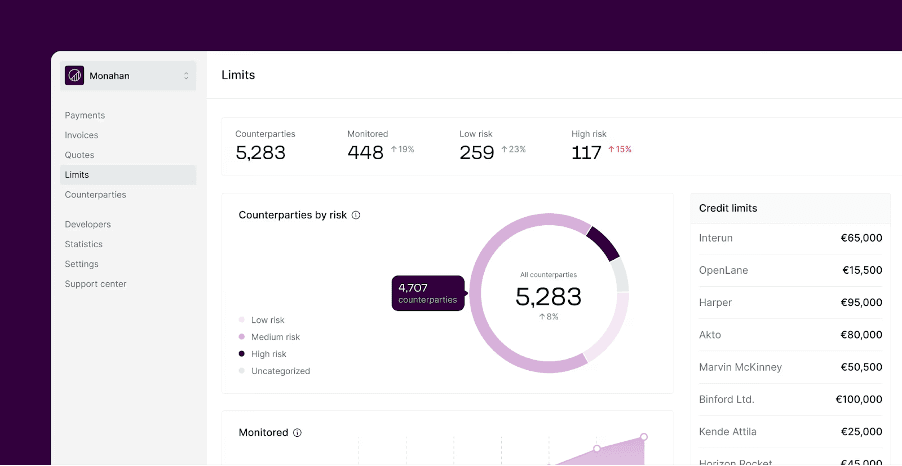
In short, your suppliers get paid faster, your team spends less time on manual checks, and financing can grow alongside your marketplace.
Keep your current workflow intact with a flexible API-first solution
Scaling payouts shouldn’t mean rebuilding your operations from scratch. The right financing layer fits into the way you already work.
With Aria, you get an API-first, fully flexible toolkit that adapts to your workflows. Our REST APIs can be integrated wherever invoice data exists – POS, ERP, CRM, online or offline sales – while user interfaces remain fully white-labelled to keep your brand front and centre.
You don’t have to integrate everything all at once. Some marketplaces start with our manual dashboard, then move to a deeper API integration over time.
You also have control over the fee structure. You can:
- Absorb the financing cost and integrate it into your pricing
- Transparently pass the fee on to suppliers
How Ubooker achieved 25% growth in booking volume by paying 3,000+ models faster with Aria
For models juggling rent, portfolios, and travel between gigs, waiting 30, 60, or even 90 days for payment can be stressful. Ubooker, a platform connecting brands with models worldwide, wanted to change that. They believed in fair, prompt payments for their talent – but brands still needed their usual payment terms.
Ubooker faced a dilemma: delay payments and strain relationships with models, or use their own cash to bridge the gap.
Aria provided an alternative solution. Integrated directly into the booking platform, our APIs let models request payment from Aria with a click, while brands maintain their standard terms. Ubooker preserves its cash flow, and payouts happen automatically.
Models now get paid within seven days of completing a job, which encourages them to take more bookings and refer friends. Meanwhile, Ubooker is able to attract more brands that want to maintain their accounting cycles while supporting fair compensation.
Ubooker’s internal operations improved, too. Support tickets about payment delays practically disappeared, freeing the team to focus on growth. With payment friction removed, booking volume has climbed 25% year on year.
Get the full details on how Ubooker scaled bookings with faster payouts.
Embedded invoice financing enables faster, more reliable payouts for marketplaces
As a scaling B2B marketplace, you face competing pressures: sellers want fast, predictable payouts, while buyers expect 30, 60, or 90-day payment terms. Covering the difference yourself ties up working capital and adds operational burden as your team handles manual workflows and collections.
Aria helps solve this by combining funding with embedded automation. We advance payments to your sellers quickly so that you don’t have to front the cash. At the same time, our API integrates with your existing marketplace workflows to automate payouts while we manage credit risk and collections in-house for you.
As a result, your sellers get paid reliably, and your team can focus on growth instead of cash flow headaches.
Book a demo today to see how Aria can improve payouts for your marketplace.
FAQs on marketplace payouts
How do marketplace payouts work in B2B marketplaces?
Marketplace payouts move funds from buyers to sellers, typically minus fees, commissions, and taxes. Depending on the model, the marketplace may act as the merchant of record or only facilitate payments. Sellers invoice the marketplace or the buyer, payments are collected, and disbursements are released according to agreed terms.
Many global marketplace platforms also leverage payment solutions like Aria to streamline operations and bridge timing gaps through optional invoice financing.
What challenges do marketplaces face with payouts as they scale?
As marketplace operations grow in scale, manual processes, delayed payments, and complex fee calculations create operational strain. Extended buyer terms can tie up cash and delay seller payments. Managing reconciliation, compliance, and accurate payouts across a high volume of sellers can become increasingly difficult without automation, robust functionality, and financing solutions like Aria.
How can marketplaces pay sellers without using their own cash?
Marketplaces can partner with embedded invoice financing providers like Aria. Aria advances payments to sellers based on buyer credit, often within 24 hours, while buyers settle according to their terms. This protects the marketplace’s working capital while ensuring predictable seller payouts – even for multi-currency, global payments.
What payment options can marketplaces offer sellers?
Marketplaces can provide a range of payout solutions depending on geography and seller preference. These may include direct bank account transfers, wallets, or local payment methods for international sellers.
Supporting multiple payout rails improves accessibility for marketplace sellers and enables smoother global payouts.
How do payouts work for global marketplaces?
For e-commerce and B2B platforms operating internationally, the payout infrastructure must handle routing, currency conversion, regulatory requirements, and cross-border compliance. Payment solutions like Aria help manage multi-currency settlements while ensuring funds reach sellers quickly.