Escrow platforms for online purchases: how to use them for services and products
Discover how escrow platforms help secure online purchases and why B2B marketplaces use embedded invoice financing as the next step to improve cash flow and scale.

If you’re building a B2B marketplace, you know that trust is an integral part of what makes it work. Specifically, that means a reliable way to protect both buyers and sellers during transactions. Without it, you could run into issues like:
- Buyers refusing to pay or filing chargebacks despite receiving what they ordered
- Sellers accepting payment and never delivering
- Your refund policy being taken advantage of
When these situations happen, marketplaces often end up stuck in the middle. To keep users happy, you might have to absorb the financial loss yourself. And even if you don’t step in, repeated disputes can chip away at trust, lead to poor reviews, and ultimately push users off your platform.
Escrow payments help solve this issue. As the neutral third party, an online escrow service holds funds until all agreed-upon terms are met, which helps create secure transactions.
But once transactions are securely flowing, another challenge surfaces: how can you accelerate supplier payouts while allowing buyers to keep their regular payment terms? After all, marketplaces need more than transaction security. They need transaction velocity.
This is where embedded financing payment solutions come into play.
In this guide, we’ll cover:
- How escrow platforms work
- Why embedded invoice financing is the next step for scaling marketplaces
- How embedded invoice financing works with Aria
- How Aria helped Comet satisfy payment demands of both corporate clients and freelancers and grow by 70%
Aria is an embedded invoice financing solution built for B2B marketplaces, including talent & staffing and ecommerce platforms in the United Kingdom. Find out how we can fit into your workflow with a free demo.
How escrow platforms work
Think of escrow as a trusted middle layer in a transaction. The money doesn’t go straight from buyer to seller – instead, it’s held safely by a third party until all work has been completed.
For sellers, this means peace of mind knowing that the buyer actually has the funds and that those funds will be released once the job is done. For buyers, it ensures payment won’t reach the seller until the product or service is delivered as expected.
Here’s how the escrow transaction process usually works:
- The buyer purchases from the seller and agrees to the seller’s terms.
- The buyer sends the payment, with the funds going into the escrow account.
- The escrow platform alerts the seller that funds are in place.
- The seller delivers the product or completes the service.
- The buyer accepts delivery and verifies their satisfaction.
- Once verified, the escrow platform releases the money to the seller.
For online marketplaces, the easiest option is a digital escrow solution that fits right into the checkout process. This can involve users clicking a button that redirects them to a separate website to complete the transaction. There are also escrow platforms that run quietly in the background for a more integrated, end-to-end experience.
Escrow platforms do come with fees. They might charge the escrow fee based on a percentage of the transaction value or a flat rate, and sometimes, there are added costs for extra services. You can choose to pass those fees on to buyers or sellers, or even to absorb the cost yourself.
It’s worth noting that, in most cases, escrow benefits buyers the most. This is because payment only moves when they confirm everything is in order. Sellers can benefit – for example, in product-based marketplaces where suppliers won’t ship until funds are securely held in escrow – but this setup has its limitations.
While escrow plays a role in establishing trust, it doesn’t address the issue that sellers face once work has been completed or goods have been delivered: waiting to get paid. This is because escrow isn’t designed to solve cash flow challenges.
Embedded invoice financing is.
Why embedded invoice financing is the next step for scaling marketplaces
Escrow solves the foundational challenge of online marketplaces: trust. But as your platform scales, a new bottleneck emerges: cash flow friction.
Take the long payment cycles that sellers often deal with: buyers commonly expect 30- to 90-day terms, which can leave sellers struggling to cover everyday expenses. Even with escrow in place, funds stay locked up until all conditions are met and any potential disputes are resolved.
This can create cash flow pressures for sellers and slow down their ability to operate and grow. Faster access to funds would help them sell more, scale faster, and keep your marketplace growing.
This is where embedded invoice financing comes in.
Like escrow, an invoice financing solution acts as a third-party intermediary. But instead of just holding and releasing the money, it can advance payments to sellers using its own funds as soon as an invoice is approved. The invoice financing provider then collects the expected payments from the buyer on regular terms.
And because it’s embedded directly into your platform, the process stays within your marketplace. Sellers get faster access to cash, buyers pay on terms that work for them, and your users stay engaged and loyal to your platform.
How embedded invoice financing works with Aria
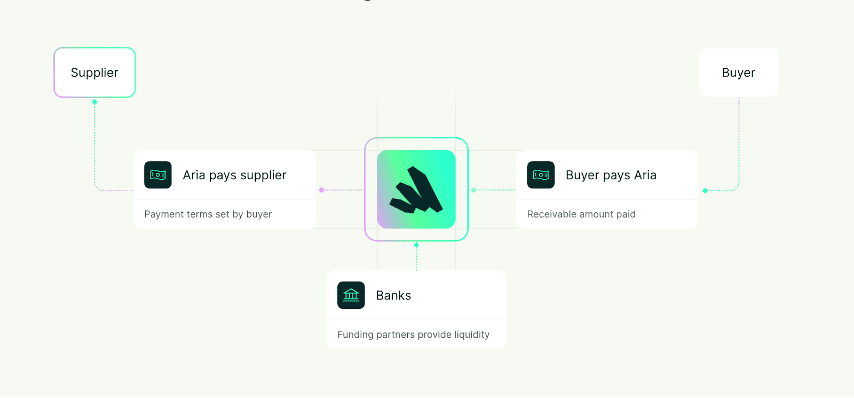
Aria is an embedded invoice financing solution designed for B2B marketplaces. With us as your financing partner, you can pay your suppliers within 24 hours while letting buyers stick to their preferred payment terms.
Because we’re integrated directly into your workflow, users can sign up and onboard right on your marketplace. Sellers can request instant payments with just a click, and buyers continue paying through your platform.
At the same time, Aria keeps transactions safe. Here’s how we help protect against fraud and disputes:
- Identity checks: We perform KYC/KYB checks to make sure everyone is who they say they are.
- Fraud detection: Our engine analyses external data on each party to minimise the risk of bad actors.
- Credit assessment: We underwrite buyers instead of sellers, which means we can extend financing even to smaller suppliers who often get rejected by traditional banks. When assessing the buyers’ solvency, we recommend appropriate credit limits. Our default rate is currently just 0.1%.
With Aria, your buyers can enjoy peace of mind via our invoice validation process.
- If you’re a service marketplace: Once a buyer validates work completion and an invoice is issued, Aria advances payment to the seller.
- If you’re a goods marketplace: An invoice is created as soon as the seller ships the product. Aria then waits for the buyer to confirm receipt before advancing payment to the seller.
For sellers, the benefit is faster access to their payments. Once an invoice is validated, Aria can advance the funds straight away, often within 24 hours. Sellers don’t have to worry about chasing payments or about potential defaults. Aria collects payments from the buyer, and if a buyer can’t pay, we absorb the loss.

With these features in place, sellers enjoy improved cash flow, buyers get the security they need, and your marketplace can grow without friction.
These are some other reasons B2B marketplaces like Malt, Job & Talent, and StaffMe work with Aria:
Keep users on your marketplace with embedded, white-label features
One of the biggest perks of Aria is that your users never have to leave your platform. Unlike solutions that redirect buyers and sellers to a third-party website, Aria integrates directly into your marketplace. Everything can be embedded and white-labelled, so it feels like a natural part of your product.
Because we’re connected to your system, we pull in user data automatically and receive invoices the moment they’re created. No manual uploads required. Sellers can request instant payments with a single click, and buyers continue paying through your platform as usual – with the funds automatically flowing to Aria behind the scenes.
On top of that, our flexible APIs support seamless API integration, which means you can customise the payment experience to match your workflows and brand. Whether it’s handling fees, splitting payments, or customising any other part of the process, we adjust to your setup. No rebuilding required.
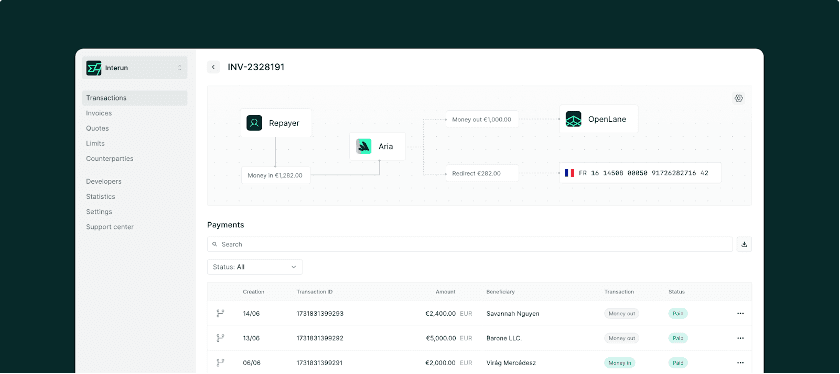
Plus, our APIs automate your payment flows: 99% of payments are automated with Aria, so your team can focus on growing the marketplace instead of manually processing payments.
Scale confidently with API-first technology and reliable customer support
Growing your marketplace shouldn’t mean getting bogged down in long approval processes or complicated integrations. That’s why we built Aria with API-first technology that makes it easy to offer financing even as you scale.
Typically, all we need is a company registration ID to determine financing limits and advance funds. Risk checks that normally take days happen automatically and in near real-time, with 92% instant decisioning, so new users can onboard and access financing right away. The faster they start transacting, the faster your marketplace grows.
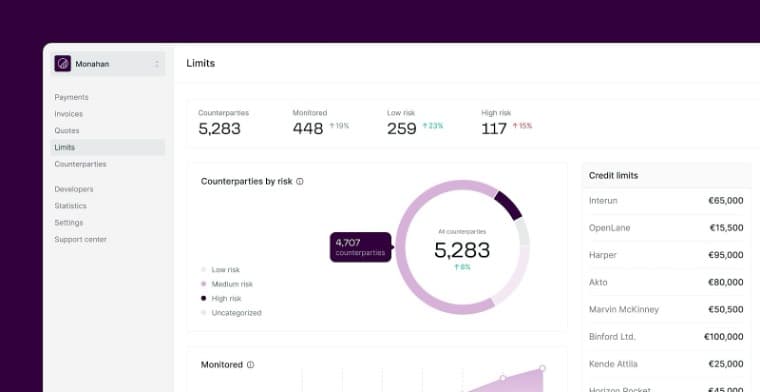
We have the capacity to back that growth. With €2 billion in financing available, we can handle spikes in transaction volume – if your user base doubles overnight, we’re ready for it.
We also make sure you’re supported every step of the way. During onboarding, an implementation manager will help tailor Aria to your platform. Once you’re up and running, a dedicated account manager is always just an email away to answer any questions. No chatbots, no being passed around from rep to rep – just someone who knows your marketplace and can ensure Aria grows with you.
How Aria helped Comet satisfy the payment demands of both corporate clients and freelancers
Comet connects IT freelancers with major companies for long-term projects. Every month, nearly 600 freelancers are fully employed through Comet – and expect to get paid promptly for their work.
The challenge for Comet is balancing the needs of two very different groups. Corporate clients typically pay on 30- to 60-day terms, while freelancers need quick access to their earnings to cover everyday expenses. Comet couldn’t realistically self-fund hundreds of millions in transactions each year, so they turned to Aria.
Aria streamlined the process. With our technology, advances are approved directly based on invoices, requiring only the freelancer’s verified time logs. Once the logs are submitted, payments can be released within 24 hours. Freelancers get their money fast, corporates stick to their usual terms, and Comet doesn’t have to worry about funding gaps.
Thanks to Aria, Comet has gained a real competitive advantage. The marketplace’s ability to settle invoices within days was a huge factor in retaining its freelance community. Meanwhile, predictable payment terms kept corporate clients comfortable. A 70% annual growth rate speaks for itself!
Offer sellers instant liquidity while protecting every transaction
By holding funds until conditions are met, escrow platforms help create trust and reduce risk, which is a critical foundation for any marketplace.
But once trust is established, scaling marketplaces face another issue: with growing transaction volumes, it’s vital for sellers to receive liquidity upfront while buyers keep paying on their usual terms.
Embedded invoice financing builds on escrow solutions by addressing these liquidity issues. With Aria, for example, funds can typically be advanced to sellers within 24 hours, regardless of the buyer’s agreed payment terms.
And the entire experience stays inside your marketplace. With our solution, onboarding, risk checks, and financing run automatically in the background. You can start quickly using our dashboard and, when ready, scale at your pace with fully embedded APIs that match your brand and workflow.
Want to see how it works? Request a free demo today.
FAQs: Escrow platforms for online purchases
What is an escrow platform?
An escrow platform is a neutral third party that holds funds during a transaction. The money doesn’t go straight to the seller – instead, it’s held by the escrow provider until the product or service has been delivered. By using escrow, marketplaces can therefore enable secure payments by protecting both sides of the transaction.
How does an escrow platform work for online purchases?
In a typical online escrow process, the buyer sends payments into a secure escrow account. The seller is notified and delivers the product or completes the service. Once the buyer confirms everything is as expected, the escrow platform releases funds to the seller.
Some escrow solutions are embedded and work in the background of the online store or marketplace. Others redirect users to an external website to complete the payment.
Do marketplaces need an escrow platform?
Marketplaces don’t always need to use escrow, but they do need a mechanism that protects buyers and sellers. Escrow is effective at reducing fraud and dispute risks, especially for high-value or first-time online transactions. However, it doesn’t address sellers’ cash flow challenges, which is an essential problem to solve for marketplaces that want to retain users and grow.
How does Aria differ from typical escrow solutions?
Escrow solutions help establish trust by holding funds until a transaction is validated. Aria builds on that foundation by addressing the next challenge marketplaces face as they scale: how to keep money moving efficiently once trust is in place.
Once a buyer validates an invoice, Aria can advance payouts to the seller – often within 24 hours – while the buyer pays later on their usual terms. Everything happens inside your marketplace through embedded, white-label features that support secure transactions. This means users stay on your platform and transactions flow automatically in the background.