Alternatives to traditional factoring for B2B marketplaces (and providers that support it)

Different models include embedded invoice financing, reverse factoring and dynamic discounting.
Factoring was designed for bilateral supplier–buyer relationships, not for platforms managing thousands of suppliers, high invoice volumes, and complex workflows. As a result, many marketplaces now look for alternatives that are faster, more scalable, and better aligned with platform economics.
The most common alternatives to traditional factoring used by B2B marketplaces today are:
- Embedded invoice financing (e.g. Aria)
- Reverse factoring / supply chain finance (e.g. C2FO)
- Dynamic discounting (e.g. SAP Taulia)
Each model improves cash flow in a different way and suits different marketplace structures.
Why traditional factoring struggles in B2B marketplaces
In a classic factoring model:
- A supplier sells an invoice to a factor
- The factor advances part of the invoice value
- The factor later collects payment from the buyer
While the structure is simple, execution is often misaligned with marketplace needs.
Common issues include:
- Manual onboarding and paperwork-heavy applications
- Slow credit and risk assessments
- Strict eligibility thresholds that exclude small or newer suppliers
- Financing that happens entirely outside the marketplace experience
For a marketplace, this creates several problems:
- Suppliers leave the platform to seek liquidity
- Approval outcomes are inconsistent and opaque
- Payout speed varies by supplier
- Supplier retention suffers over time
Modern marketplace financing models were designed specifically to remove these bottlenecks.
Embedded invoice financing: factoring built into the marketplace
Embedded invoice financing keeps the economic logic of factoring, third-party capital pays suppliers early and collects from buyers later, but moves the entire process inside the marketplace.
Instead of suppliers applying with a bank or factor, financing becomes a native product feature.
How embedded invoice financing works
- Suppliers choose which invoices they want to finance
- Credit checks, KYC/KYB, and compliance run automatically
- Funds are advanced once invoices are validated
- Collections, disputes, and default risk are handled by the financing provider
Because the flow is embedded, suppliers never leave the platform and the marketplace retains control over UX and data.
Example: Aria
Aria is an example of an embedded invoice financing provider built specifically for marketplaces and SaaS platforms.
Its model aligns incentives across all three parties:
- Suppliers get faster access to cash without bank-style onboarding
- Buyers continue paying on standard terms (30, 60, or 90 days)
- Marketplaces avoid tying up capital or taking credit risk
A defining characteristic of embedded invoice financing is buyer-based underwriting. Instead of assessing whether a supplier qualifies, the financing decision is based on the buyer’s ability to pay.
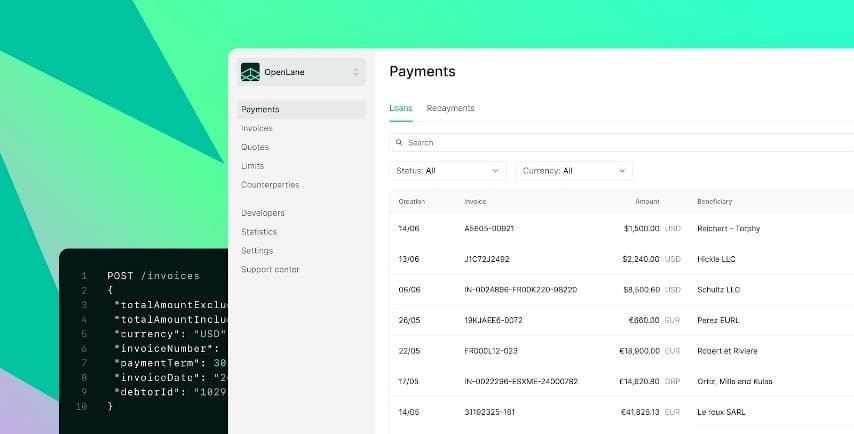
This allows:
- Small or long-tail suppliers to access liquidity
- Financing to scale across high invoice volumes
- Consistent eligibility across the supplier base
When embedded invoice financing works best
- Supplier churn is driven by slow payment cycles
- Advancing payouts internally is straining working capital
- Risk and compliance operations are becoming heavy
- You operate across multiple markets, currencies, or supplier types
“Factoring was built for one supplier and one buyer. Marketplaces need something very different: financing that scales across thousands of invoices, stays on-platform, and doesn’t pull suppliers into bank-style processes.” – Tom Lamb, Payment Expert at Aria
Reverse factoring: buyer-led supply chain finance
Reverse factoring, also known as supply chain finance, flips the initiation logic.
Instead of suppliers requesting financing, the buyer (or the marketplace on behalf of the buyer) initiates the program.
How reverse factoring works
- The buyer approves an invoice
- A financing partner pays the supplier early
- The buyer repays the financing partner on the original due date
The key distinction is that financing terms are based on the buyer’s credit profile, not the supplier’s.
There are two additional points that matter in practice:
First, the buyer (the debtor) must have very strong financials to be eligible for a reverse factoring program in the first place. Second, while the program is enabled by the buyer, the financing fee is typically paid by the supplier, meaning early payment is optional and comes at a cost for them.
For example, L’Oréal might run a reverse factoring program with a financing partner. Malt, as a supplier to L’Oréal, could then choose to have its invoices paid early under that program. If Malt opts in, it pays a financing fee, and crucially, this doesn’t automatically accelerate payments to Malt’s own suppliers.
In another scenario, a freelancer might invoice L’Oréal directly through a marketplace and indirectly benefit from L’Oréal’s reverse factoring program. In most cases, however, the marketplace itself isn’t actively involved in the financing relationship, it simply sits outside the buyer–supplier setup.
Example: C2FO
C2FO supports reverse factoring as part of a broader working capital optimisation platform, with a strong focus on early payment programs. The model is widely used by large, creditworthy buyers with extensive supplier networks.
For marketplaces, reverse factoring can:
- Guarantee early payment for suppliers
- Allow buyers to extend payment terms without harming suppliers
- Lower financing costs compared to supplier-led factoring
When reverse factoring works best
- The marketplace has a concentrated base of strong buyers
- Buyer relationships are stable and long-term
- The goal is to optimise working capital across the supply chain
Reverse factoring is less effective in fragmented marketplaces with many small buyers or limited buyer credit visibility.
Dynamic discounting: early payment without external debt
Dynamic discounting removes third-party lenders entirely. Instead of selling invoices, suppliers offer discounts in exchange for early payment, funded directly from available liquidity.
How dynamic discounting works
- The earlier an invoice is paid, the larger the discount
- Discount rates adjust dynamically based on timing
- No external financing or collections process is involved
Example: SAP Taulia
SAP Taulia offers dynamic discounting as part of its broader payables and working capital suite. It is often positioned as a way to turn excess cash into yield rather than letting it sit idle.
Benefits and constraints
Dynamic discounting can be attractive because:
- There is no debt or credit underwriting
- Supplier cash flow improves
- Discounts may outperform idle cash returns
However, it is inherently constrained by liquidity. If cash tightens, early payments slow unless the model is combined with third-party financing.
When dynamic discounting works best
- The marketplace or buyers have surplus cash
- Early payment is a nice-to-have rather than mission-critical
- Simplicity is preferred over maximum coverage
How to choose the right alternative to factoring
Each model serves a different marketplace objective:
- Embedded invoice financing (e.g. Aria): Best for scalable, marketplace-native liquidity that serves long-tail suppliers and removes credit risk from the platform.
- Reverse factoring (e.g. C2FO): Best when strong buyers anchor the ecosystem and buyer credit strength can be leveraged.
- Dynamic discounting (e.g. SAP Taulia): Best when liquidity is abundant and early payment can be funded internally.
Many mature marketplaces combine these approaches to serve different buyer and supplier segments.
Embedded invoice financing could be a good fit for you
Traditional factoring was not designed for the speed, scale, and diversity of B2B marketplaces.
Embedded invoice financing, reverse factoring, and dynamic discounting offer more flexible, modern alternatives. Each improves cash flow in a different way, without forcing marketplaces into slow, bank-centric operating models or balance-sheet risk.
For platforms built around growth, supplier retention, and operational leverage, factoring is no longer the default.
Frequently asked questions
What is the main difference between traditional factoring and embedded invoice financing?
Traditional factoring requires suppliers to apply separately with a bank or factor and sell invoices off-platform. Embedded invoice financing is built directly into a marketplace, allowing suppliers to choose early payment within the platform while a third party handles credit risk and collections. The key difference is that embedded models are automated, scalable, and marketplace-native.
Do marketplaces need to take credit risk to help suppliers get paid faster?
No. Modern alternatives to factoring, such as embedded invoice financing and reverse factoring, allow suppliers to receive early payment while credit risk is absorbed by a financing provider. The marketplace does not lend money or hold receivables on its balance sheet.
How is reverse factoring different from supplier-led factoring?
In reverse factoring, financing is initiated by the buyer (or by the marketplace on the buyer’s behalf) and priced based on the buyer’s creditworthiness. In supplier-led factoring, each supplier is underwritten individually. Reverse factoring typically offers lower financing costs but works best when buyers are large and creditworthy.
When does dynamic discounting make more sense than third-party financing?
Dynamic discounting is most suitable when buyers or marketplaces have surplus cash and want to pay suppliers early in exchange for a discount. It does not rely on external lenders but is limited by available liquidity. If cash becomes constrained, dynamic discounting may need to be supplemented with third-party financing.
Can marketplaces use more than one alternative to factoring?
Yes. Many mature B2B marketplaces use a combination of embedded invoice financing, reverse factoring, and dynamic discounting to serve different buyer and supplier segments. For example, long-tail suppliers may rely on embedded financing, while large strategic buyers participate in reverse factoring programmes.
Sources:
- https://c2fo.com/glossary/supply-chain-finance/
- https://c2fo.com/resources/finance-and-lending/what-is-supply-chain-finance/
- https://taulia.com/platform/payables/dynamic-discounting/
- https://taulia.com/platform/payables/supply-chain-finance/
- https://taulia.com/platform/enterprises/working-capital-improvement/